The Rise
 On Sept. 1, 1969, Gaddafi and a group of young officers seized power in a bloodless revolution. The charismatic Gaddafi, only 27 at the time, soon emerged as the country’s paramount leader and quickly tried to establish himself as an anti-Western iconoclast. He forced out U.S. and British military forces and, over the next two decades, invited in every shade of radical from the Palestine Liberation Organization to the Irish Republican Army.
He abolished the Libyan Constitution of '51 and established himself as the power centre based on his political ideology by eliminating any opposition and shows himself as the Brother Leader by severely restricting the lives of ordinary Libyans. He resents the Western powers and only allows their oilfields to be operation on the condition that Libya owns more percentage of the profit which the oil companies complies with 79-21 in Libya's favour. He is the longest-ruling Arab leader for nearly 42 years in power.
 On Sept. 1, 1969, Gaddafi and a group of young officers seized power in a bloodless revolution. The charismatic Gaddafi, only 27 at the time, soon emerged as the country’s paramount leader and quickly tried to establish himself as an anti-Western iconoclast. He forced out U.S. and British military forces and, over the next two decades, invited in every shade of radical from the Palestine Liberation Organization to the Irish Republican Army.
He abolished the Libyan Constitution of '51 and established himself as the power centre based on his political ideology by eliminating any opposition and shows himself as the Brother Leader by severely restricting the lives of ordinary Libyans. He resents the Western powers and only allows their oilfields to be operation on the condition that Libya owns more percentage of the profit which the oil companies complies with 79-21 in Libya's favour. He is the longest-ruling Arab leader for nearly 42 years in power.
In more than 40 years as leader of Libya, Moammar Gaddafi has bedeviled, but also surprised the world. But has his grip on power finally been loosened by the wave of popular uprisings washing over the Arab world?
("The rise and fall of Libyian leader Moammar Gaddafi", 2011)
The Fall
 In the 2011 revolution, Libyan rebels swarmed into the highly symbolic Green Square at the heart of Tripoli early Monday, merely two days after they launched an offensive against the capital in the final push against Colonel Muammar Gadhafi's government. The obviously minuscule resistance put on by pro-Gadhafi forces marked a sharp contrast with the muscular defiance put up by their embattled leader, who had repeatedly and passionately urged his followers to fight till the end. The suprise advance by the rebels was a logical outcome of the overall dynamics in and beyond Libya, which had seen the rebels reap more and more gains on both the battleground and the diplomatic front and the government crunch along under increasing pressure.
("Libyan rebels in Tripoli, Gadhafi defenses collapse," 2011)
("The rise and fall of Libyian leader Moammar Gaddafi", 2011)
The Fall
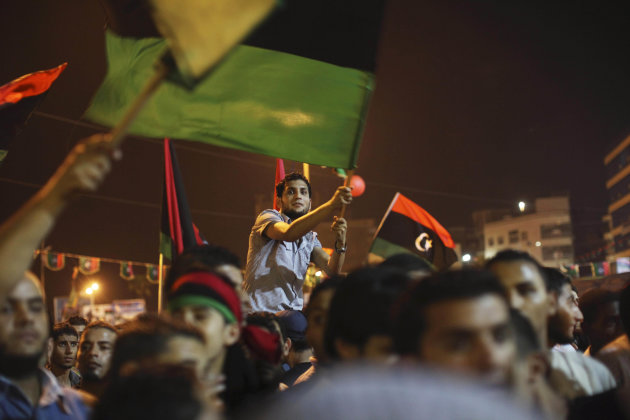 In the 2011 revolution, Libyan rebels swarmed into the highly symbolic Green Square at the heart of Tripoli early Monday, merely two days after they launched an offensive against the capital in the final push against Colonel Muammar Gadhafi's government. The obviously minuscule resistance put on by pro-Gadhafi forces marked a sharp contrast with the muscular defiance put up by their embattled leader, who had repeatedly and passionately urged his followers to fight till the end. The suprise advance by the rebels was a logical outcome of the overall dynamics in and beyond Libya, which had seen the rebels reap more and more gains on both the battleground and the diplomatic front and the government crunch along under increasing pressure.
("Libyan rebels in Tripoli, Gadhafi defenses collapse," 2011)
Although it remains unclear where Gadhafi is now and how he is going to react, there is no doubt that the rebels' advance into Tripoli has tipped the war heavily in their favor. As Libya heads for a post-Gadhafi era, however, the troubled North African country faces a host of daunting rehabilitation challenges, given its acute political pains and socioeconomic woes. The most pressing question is who can fill the power vacuum and lead the severely scathed country in postwar reconstruction and put the life of the over 6.4 million Libyans back on track. Despite the pledge by the Benghazi-based National Transitional Council (NTC), the primary rebel group, to organize a general election and transform Libya into a democratic country, many fear that the country of numerous tribes and factions might be reduced to another Somalia.
("Lybia - Revolution 2011," 2011)
The fall of Moammar Gaddafi ends the rule of one of the most mercurial and menacing figures in recent history — the “mad dog” sponsor of international terrorism who allied himself with the George W. Bush administration’s war on terror; the pan-Arabist who at one time or another alienated nearly all of his Arab brethren; and the self-styled revolutionary philosopher who, in the end, was just another violent dictator clinging to power.
("Lybia - Revolution 2011," 2011)
The fall of Moammar Gaddafi ends the rule of one of the most mercurial and menacing figures in recent history — the “mad dog” sponsor of international terrorism who allied himself with the George W. Bush administration’s war on terror; the pan-Arabist who at one time or another alienated nearly all of his Arab brethren; and the self-styled revolutionary philosopher who, in the end, was just another violent dictator clinging to power.

Stalin and Hitler were no different. In those days, tyranny was always in motion when someone gets the chance, only to be felled in the end consequentially for being corrupted by power. This is in a sense Arabic style, perhaps. =P
ReplyDelete