Sunday, September 25, 2011

Introduction


Lybia is a country in the Maghreb region of North Africa, bordered by the Mediterranean Sea to the north, Egypt to the east, Sudan to the southeast, Chad and Niger to the south, and Algeria and Tunisia to the west.


As a result of the 2011 Libyan civil war, there are two entities claiming to the de jure governing authority of the country.  The Tripoli-based National Transitional Council, led by Mustafa Abdul Jalil, controls most of the country and uses the short-form name Libya for the Libyan state, but has also on occasion referred to it in the long-form as the Libyan Republic.  The remnants of the previous regime and its institutions, led by Muamma Gaddafi, refer to the Libyan state as the Great Socialist People's Libyan Arab Jamahiriya and are based in the city of Sirte.  The United Nations recognizes the National Transitional Council as the sole legal representative of the country.

Sunday, September 11, 2011

Africa - The "Dark" Continent


At the end of World War II, almost all countries in Africa were still colonial territories with the exception of Egypt, Liberia, Ethiopia and South Africa.  Sixty years later, in 2005, nearly all territories became sovereign states based on universal suffrage and are members of the United Nations.  In the immediate aftermath of World War II, the colonial powers had no intention to relinguish their power to grant independence to their African colonies. 

Nevertheless, the world after 1945 had changed more than they were willing to acknowledge on account of at least three things which transformed the geopolitics of the world system -- the Cold War competition between the United States and Soviet Union; the successive independence in Asia and Southeast Asia of the Philippines, the Indian subcontinent, the Indonesia; and the Communist Party's coming to power in China.  A wave of nationalism swept through Africa, and by 1960, called the Year of Africa, more than half of Afrcia's nations became sovereign states soon followed by the other half. 

(Wallerstein, 2005)

Saturday, September 10, 2011

Politics in Lybia

Northern Africa, being so close to the middle-east, is having a lot of trouble keeping terrorist groups out of their boarders, particularly Egypt and Somalia. It is especially hard to keep these groups out because some people in these North African countries are on the side of the terrorist groups, and want to give them a safe place to hide.

Libya is literally covered by the Sahara Desert. The only exception is the narrow 1,200 mile coastline bordering the Mediterranean Sea, where almost 80% of its population resides.

Once part of the Roman province of New Africa, it was subsequently controlled by the Byzantine and Ottoman empires. In modern times it was occupied by the British and French, but since 1969, the country is led by the government of Colonel Muammar Qaddafi.
(Skreslet, 2000)

Tripoli, the ancient capital city, was designed by the Romans, and remains one of the most exotic destinations on the planet.

Oil is the driving force in the country's economy, and in fact, Libya has the highest standard of living in Africa.

In 2003 the United Nations finally voted to lift the 11-year-long sanctions because of Libya's payment of indemnity to victims and relatives of terrorism. In 2004, the United States removed all remaining sanctions, and began to establish normal diplomatic relations.

However, in recent times the country has opened its borders to inquisitive visitors interested in Roman ruins and other historic sites. Most sources still warn of potential dangers for western travelers because of the war in Iraq.
(Wright, 1969)

Muammar Gaddafi - The Leader

The Rise

On Sept. 1, 1969, Gaddafi and a group of young officers seized power in a bloodless revolution. The charismatic Gaddafi, only 27 at the time, soon emerged as the country’s paramount leader and quickly tried to establish himself as an anti-Western iconoclast. He forced out U.S. and British military forces and, over the next two decades, invited in every shade of radical from the Palestine Liberation Organization to the Irish Republican Army.
 
He abolished the Libyan Constitution of '51 and established himself as the power centre based on his political ideology by eliminating any opposition and shows himself as the Brother Leader by severely restricting the lives of ordinary Libyans.  He resents the Western powers and only allows their oilfields to be operation on the condition that Libya owns more percentage of the profit which the oil companies complies with 79-21 in Libya's favour. He is the longest-ruling Arab leader for nearly 42 years in power.

In more than 40 years as leader of Libya, Moammar Gaddafi has bedeviled, but also surprised the world. But has his grip on power finally been loosened by the wave of popular uprisings washing over the Arab world?
("The rise and fall of Libyian leader Moammar Gaddafi", 2011)


The Fall


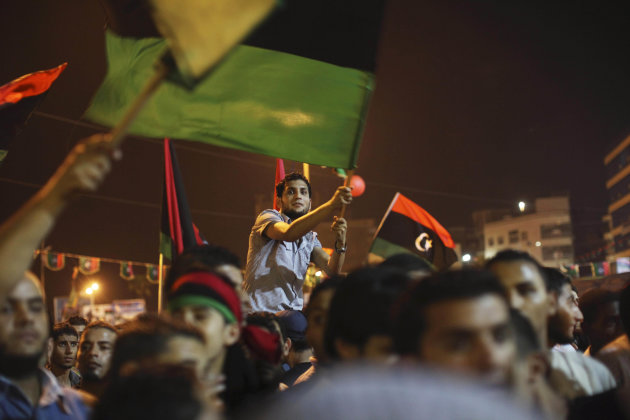
In the 2011 revolution, Libyan rebels swarmed into the highly symbolic Green Square at the heart of Tripoli early Monday, merely two days after they launched an offensive against the capital in the final push against Colonel Muammar Gadhafi's government.  The obviously minuscule resistance put on by pro-Gadhafi forces marked a sharp contrast with the muscular defiance put up by their embattled leader, who had repeatedly and passionately urged his followers to fight till the end.  The suprise advance by the rebels was a logical outcome of the overall dynamics in and beyond Libya, which had seen the rebels reap more and more gains on both the battleground and the diplomatic front and the government crunch along under increasing pressure.
("Libyan rebels in Tripoli, Gadhafi defenses collapse," 2011)

Although it remains unclear where Gadhafi is now and how he is going to react, there is no doubt that the rebels' advance into Tripoli has tipped the war heavily in their favor.  As Libya heads for a post-Gadhafi era, however, the troubled North African country faces a host of daunting rehabilitation challenges, given its acute political pains and socioeconomic woes. The most pressing question is who can fill the power vacuum and lead the severely scathed country in postwar reconstruction and put the life of the over 6.4 million Libyans back on track.  Despite the pledge by the Benghazi-based National Transitional Council (NTC), the primary rebel group, to organize a general election and transform Libya into a democratic country, many fear that the country of numerous tribes and factions might be reduced to another Somalia.
("Lybia - Revolution 2011," 2011)

The fall of Moammar Gaddafi ends the rule of one of the most mercurial and menacing figures in recent history — the “mad dog” sponsor of international terrorism who allied himself with the George W. Bush administration’s war on terror; the pan-Arabist who at one time or another alienated nearly all of his Arab brethren; and the self-styled revolutionary philosopher who, in the end, was just another violent dictator clinging to power.

Conclusion


Six months of inconclusive fighting gave way within a matter of days to an assault on Tripoli that unfolded at a breakneck pace.  By the night of Aug. 21, rebels surged into the city, meeting only sporadic resistance and setting off raucous street celebrations. Expectations grew that Colonel Qaddafi’s hold on power was crumbling as rebels overran his heavily fortified compound on Aug. 23 and finally established control after days of bloody urban street fighting.  The rebels struggled in the days that followed to restore order and services to Tripoli, while Colonel Qaddafi's whereabouts remained unknown.

The absence of the now fugitive Colonel Qaddafi and the growing influence of Islamists in Libya raises hard questions about the ultimate character of the government and society that will rise in place of Qaddafi's autocracy.  The United States and Libya’s new leaders say the Islamists, a well-organized group in a mostly moderate country, are sending signals that they are dedicated to democratic pluralism. They say there is no reason to doubt the Islamists’ sincerity.

But as in Egypt and Tunisia, the latest upheaval of the Arab Spring deposed a dictator who had suppressed hard-core Islamists, and there are some worrisome signs about what kind of government will follow.  It is far from clear where Libya will end up on a spectrum of possibilities that range from the Turkish model of democratic pluralism to the muddle of Egypt to, in the worst case, the theocracy of Shiite Iran or Sunni models like the Taliban or even Al Qaeda.

Wednesday, August 31, 2011

Reference

Wright, John L. (1969). Nations of the Modern World: Libya. Ernest Benn Ltd. Time. August 24, 2009

Skreslet, Paula Y. (2000). Northern Africa: A Guide to Reference and Information Source. Libraries Unlimited, Inc 

Wallerstein, I. (2005). Africa: The Politics of Independence and Unity. University of Nebraska Press. Lincoln NE.

Libyia - Revolution 2011. (2011, September 20). The New York Times. Retrieved September 23, 2011, from http://topics.nytimes.com/top/news/international/countriesandterritories/libya/index.html

Libyia rebels in Tripoli, Gadhafi defenses collapse. (2011, August 11). Yahoo! News. Retrieved August 11, 2011, from http://news.yahoo.com/libyia-rebels-tripoli-gadhafi-defenses-collapse-224430097.htm


The rise and fall of Libyan leader Moammar Gaddaf. (2011, August 28). The Washington Post with Foreign Policy. Retrieved August 28,2011, from http://www.washingtonpost.com/world/national-security/the-rise-and-fall-of-libyan-leader-moammar-gaddafi/2011/02/21/gIQA32NsdJ_story_1.html